
Here's an uncomfortable truth nobody tells you while you're touring that shiny new project with the rooftop infinity pool and the salesperson's perfect pitch: none of that matters if the plot next door is zoned to stay empty forever, or worse, if your own land hasn't even been legally cleared for what's being built on it.
That's where the Gurgaon Master Plan 2031 comes in. Most buyers have never opened it. Most brokers have never mentioned it. And that's exactly why the ones who do check it end up making the smarter bet.
This is the document that quietly decides which sectors explode in value over the next five years, which ones stay stuck, and which ones are sitting on legal landmines waiting for an unsuspecting buyer. Let's break it down without the bureaucratic snooze-fest.
So What Actually Is This Master Plan?
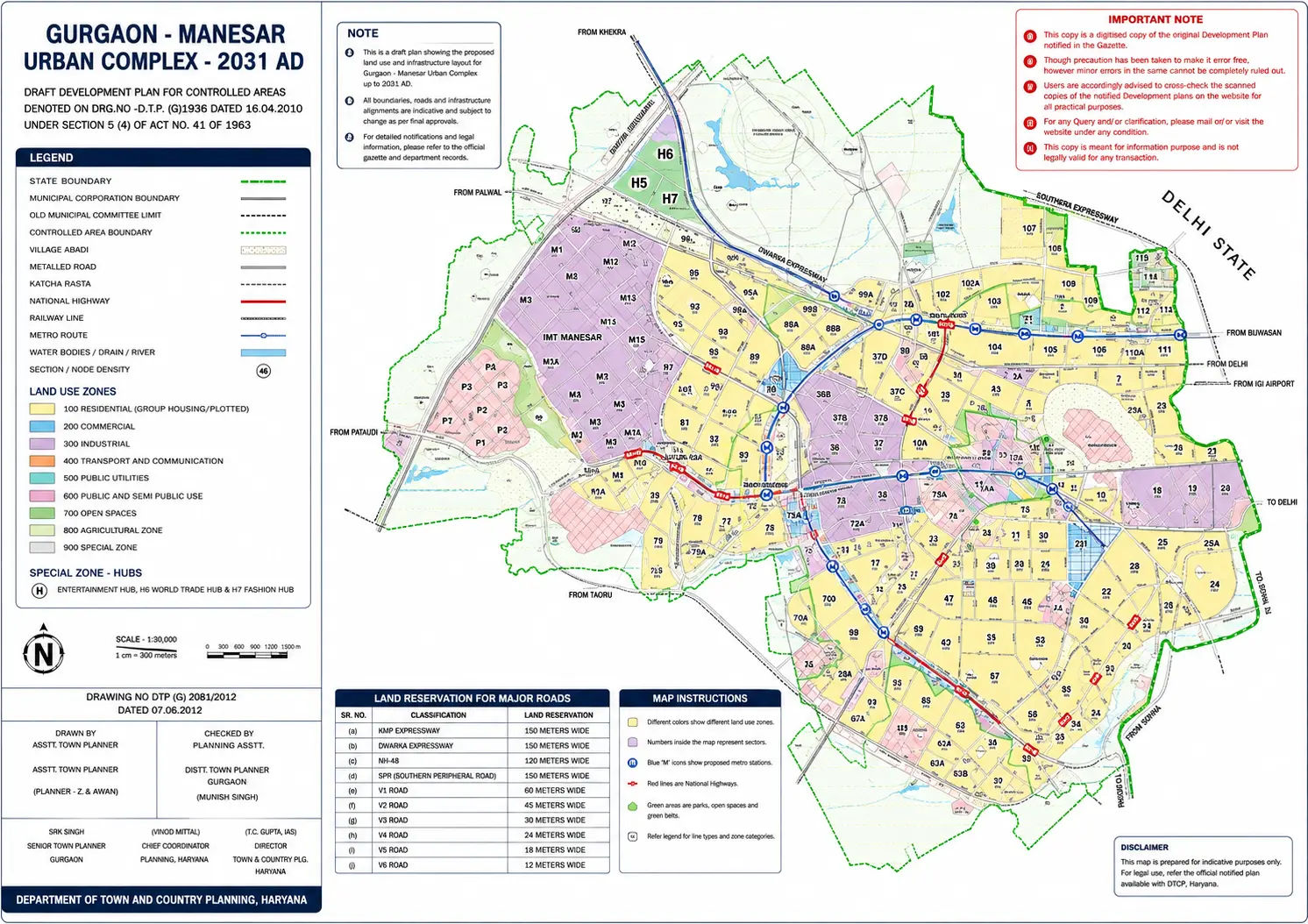
Think of it as Gurgaon's GPS for the future. Prepared by Haryana's Town and Country Planning Department, the Final Development Plan (FDP) 2031 is the master blueprint that decides what gets built where — residential towers here, industrial zones there, a strict no-construction green belt running through the middle.
Why did Gurgaon even need a new one? Because the city outgrew its older 2021 plan faster than anyone predicted. Corporate offices, IT parks, and a population boom turned quiet farmland into prime real estate almost overnight, and the old plan simply couldn't keep up. The 2031 version formally brings corridors like Dwarka Expressway, SPR, NPR, and the Manesar industrial belt into the picture — areas that used to be afterthoughts and are now the hottest growth zones in the city.
Cracking the Map Code: What Those Road Labels Actually Mean
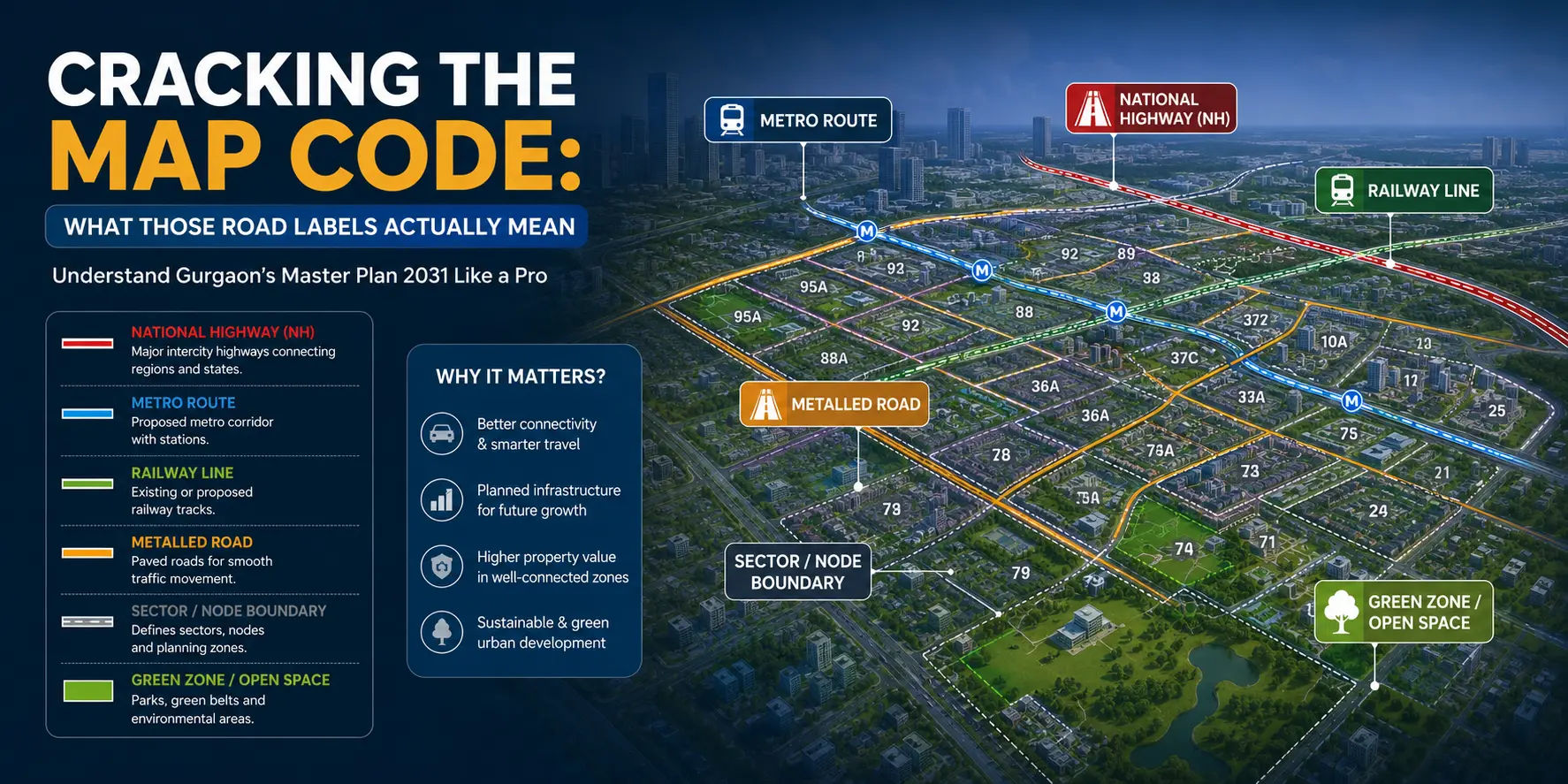
If you've ever squinted at the official map and seen codes like V-1, V-2, V-3, V-4 scattered across it and thought "what on earth is this," here's the cheat sheet — and it's genuinely the most underused piece of information in real estate decision-making:
V-1: The big boys. Existing wide highways like NH-8, flanked by generous green belts.
V-2: Major sector-connector roads, anywhere from 60 to 150 meters wide.
V-3: Internal sector roads, around 30 meters.
V-4: The smallest, around 24 meters — basically your local colony lane.
Why should you care? Because a plot sitting on a V-2 road has a fundamentally different commercial and appreciation story than one tucked behind a V-4 lane. Same sector, wildly different future.
And then there's the part everyone conveniently forgets to mention: green belts. These are marked clearly on the map as 30M, 50M, 60M, sometimes even 100M wide buffer zones running alongside major roads. Construction here is a flat-out no. Yet somehow, plots inside or bordering these zones keep getting sold to unsuspecting buyers as "future commercial gold." It isn't. It's a legal trap dressed up as an opportunity.
The Real Geography: Where Is All This Happening?
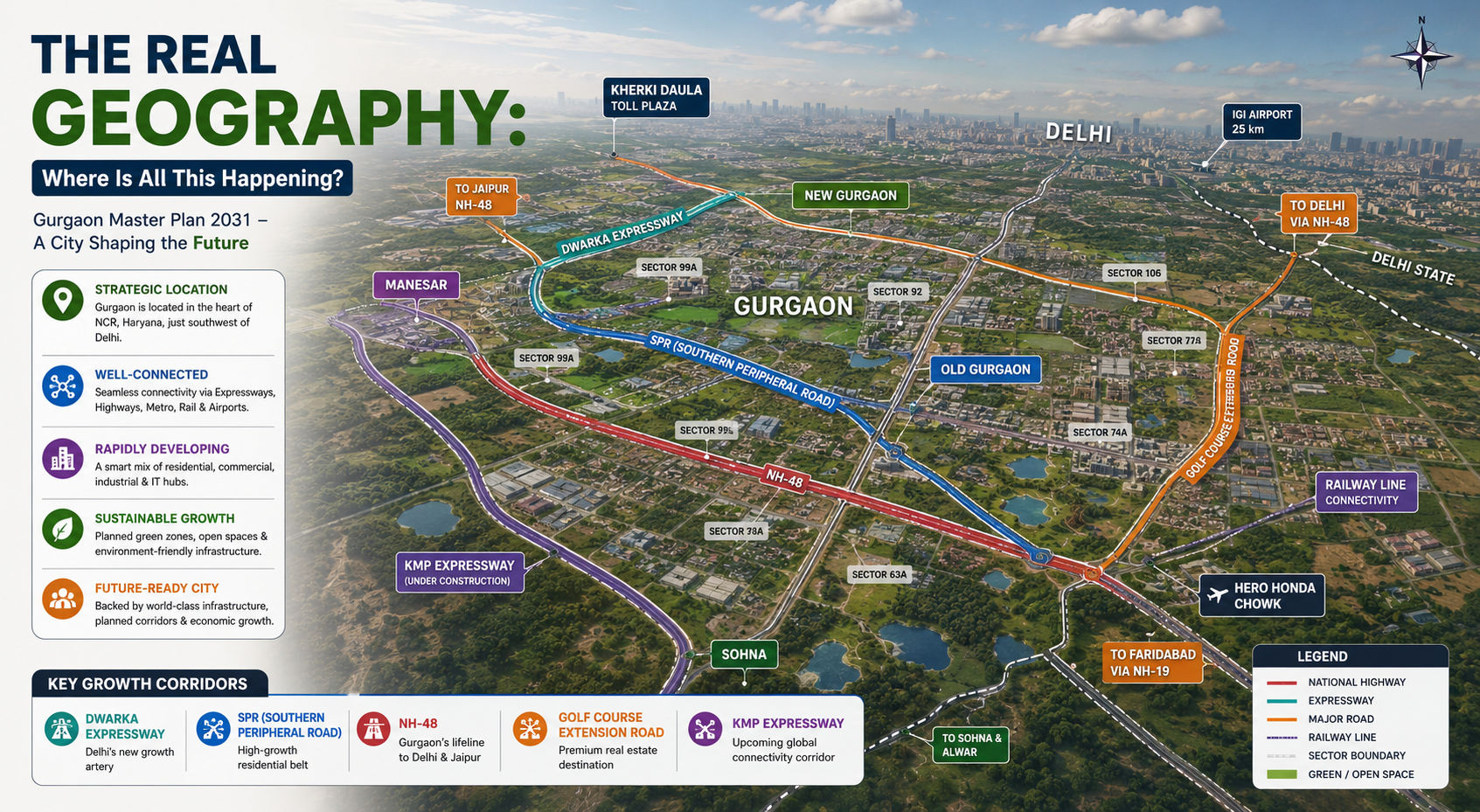
The Master Plan doesn't just cover postcard Gurgaon — it stretches across the entire Gurugram Urban Complex, including:
Old Gurgaon City (the established, already-mature sectors)
New Gurgaon (the Dwarka Expressway belt, Sectors 81-115)
Manesar and IMT Manesar (the industrial powerhouse)
The Sohna corridor
Farrukhnagar and Pataudi belt
SPR and NPR (the peripheral roads quietly becoming the new commercial spine)
Each of these zones is on a different chapter of its own growth story — some are basically finished products, others are mid-construction, and a few are still blank canvases.
Land Use: The Permission Slip Nobody Checks
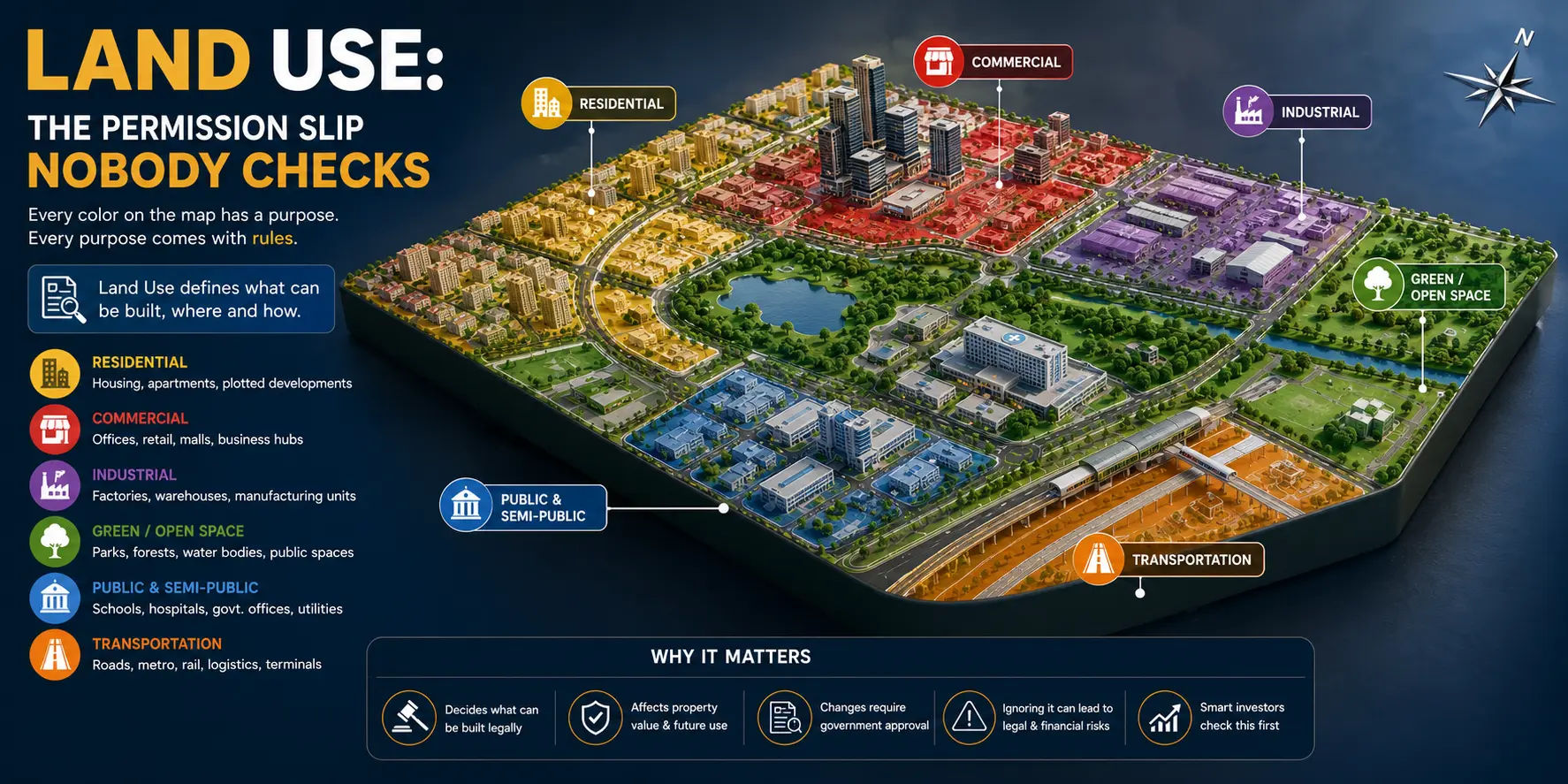
The plan splits land into clear buckets, and knowing which bucket your plot falls into is the difference between a smart buy and an expensive mistake.
Residential takes up the biggest chunk — plotted colonies, high-rise group housing, and affordable housing under the DDJAY scheme.
Commercial zones cluster heavily around SPR, Golf Course Road, and the NH-8 corridor — this is where SCO plots, retail, and office spaces get the green light.
Industrial land is concentrated around IMT Manesar, reserved for manufacturing and logistics.
Institutional pockets — schools, hospitals, universities — are scattered across nearly every sector.
Green belts and open spaces are the buffer strips along roads where construction is permanently off the table.
Here's the takeaway that actually matters: before you sign anything, check whether the land's official designated use matches what the seller is promising. Plenty of "residential" plots out there are sitting on agricultural land that hasn't even cleared CLU (Change of Land Use) approval yet. On paper, that's still farmland — no matter how convincing the brochure looks.
The Infrastructure Story: What's Actually Coming By 2031
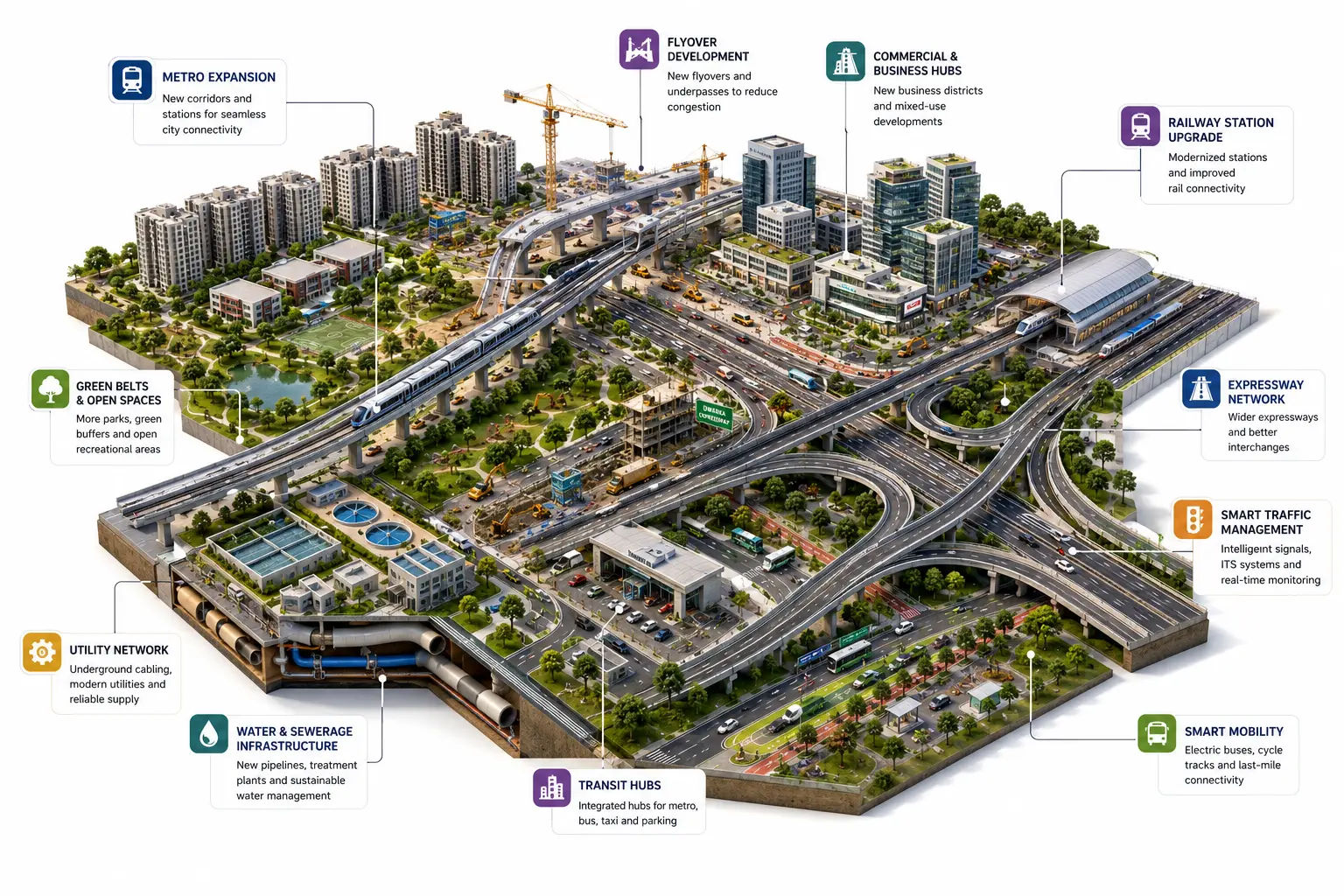
This is the part that should genuinely excite — or worry — every investor, because connectivity is the single biggest value driver in real estate, full stop.
Expressways: Dwarka Expressway is already live and has single-handedly reshaped property values across Sectors 81-115. The KMP Expressway links Manesar to the wider NCR network, and the Delhi-Mumbai Expressway adds another major artery to the mix.
Metro Expansion: Beyond the existing Rapid Metro, new routes and depots are mapped out to push connectivity deeper into IMT Manesar and the newer sectors.
RRTS and the Orbital Rail Corridor: This is the long game — regional rail infrastructure that's already nudging up land prices on the periphery, well before a single track is laid.
The pattern here is simple: sectors sitting within a 1-2 km radius of these upcoming corridors tend to see sharper appreciation than sectors relying purely on today's existing roads.
Picking Your Sector: Three Different Bets, Three Different Risk Levels
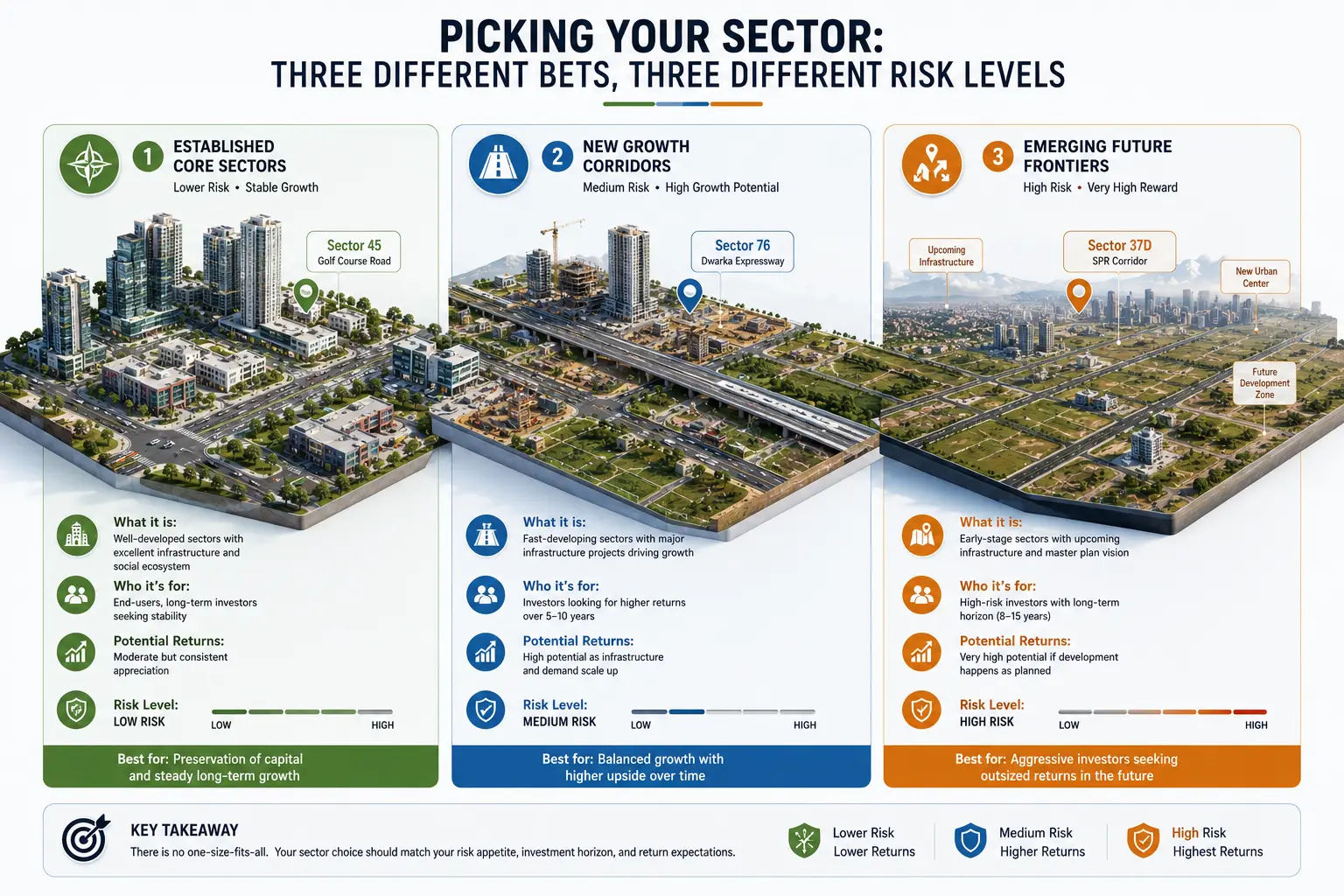
The Master Plan basically sorts Gurgaon into three flavors of investment:
Established sectors (think Golf Course Road's older pockets) — the growth story has mostly already played out. Stable, steady, low-drama appreciation.
Active growth corridors (Dwarka Expressway, SPR, Golf Course Extension) — infrastructure is actively being built right now, and demand is climbing alongside it.
Emerging zones (the far end of New Gurgaon, Sohna belt, Manesar periphery) — higher risk, but if the planned connectivity actually lands on schedule, the upside can be significant.
Which one's right for you depends entirely on your appetite for risk versus your need for certainty. There's no universally "correct" pick — just the one that matches your goals.
Five Mistakes That Cost Buyers Real Money

Falling for location alone. A great-sounding address means nothing if the land's actual designated use says otherwise.
Buying inside or near a green belt. These plots look tempting precisely because they're cheaper — and they're cheaper precisely because construction approval is a near-impossible ask.
Ignoring road-widening plans. If a road is slated to widen in the future, a chunk of the adjoining plot could get swallowed up in acquisition.
Skipping the CLU check. Agricultural land dressed up as a residential project is one of the oldest tricks in the book — and one of the easiest to verify against.
Trusting a sector number and stopping there. "It's in Sector 70" tells you almost nothing on its own. The exact plot, its road classification, and its zoning status are what actually matter.
How to Actually Verify This Yourself
Head to the DTCP Haryana official website, pull up the GIS portal, and search by sector number or khasra number to see the exact land classification. It takes about ten minutes and it's completely free — and it can save you from a mistake that costs lakhs. Before any serious investment, this step simply isn't optional.
Invest Smarter, Not Harder
The Gurgaon Master Plan 2031 isn't some dusty government file — it's the closest thing to a crystal ball this city's real estate market has. It tells you exactly where the next wave of value is building, and exactly where the hidden risks are sitting, quietly, waiting for someone who didn't check.
Anyone trusting a brochure, a smooth-talking broker, and a nice view to make a six or seven-figure decision is gambling. Anyone who spends ten minutes on the GIS portal, understands their road classification, and confirms CLU status before signing — that person is investing.