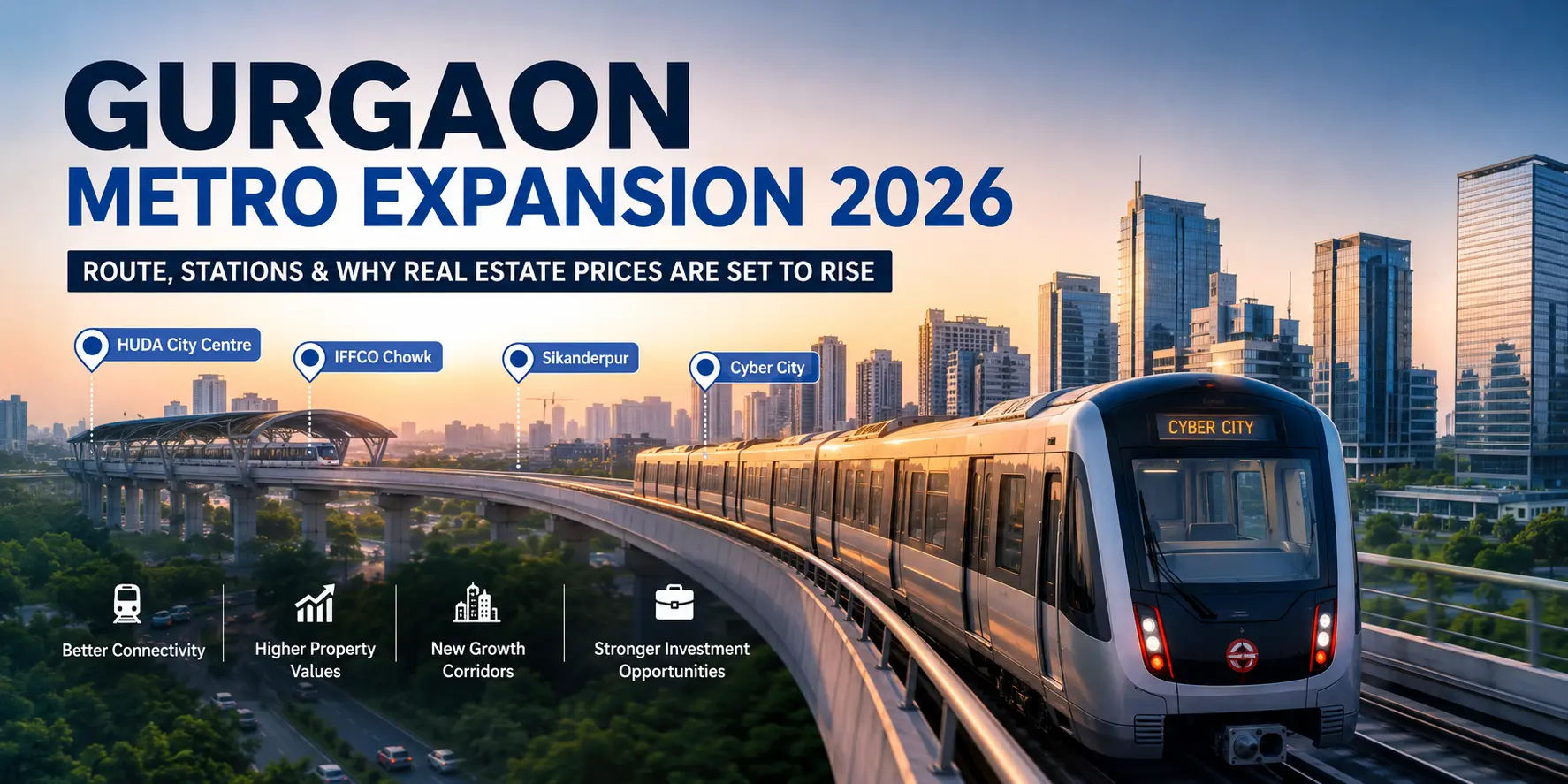
For almost a decade, "Gurgaon Metro expansion" was the real estate equivalent of a promise your friend keeps making but never actually shows up for. Everyone talked about it. Plans got drawn, redrawn, shelved, revived. Meanwhile, entire sectors of Old Gurgaon stayed metro-less while Cyber City boomed around them.
That waiting game is finally over. The 28.5 km loop line connecting Millennium City Centre (the old HUD City Centre) to Cyber City has been approved, funded, and is now under active construction. And if history with metro corridors anywhere in India has taught us anything, it's this: the sectors that get connected first are the ones that quietly mint the best returns over the next five years.
Here's everything you need to know — the route, the stations, the money, and which localities are already moving.
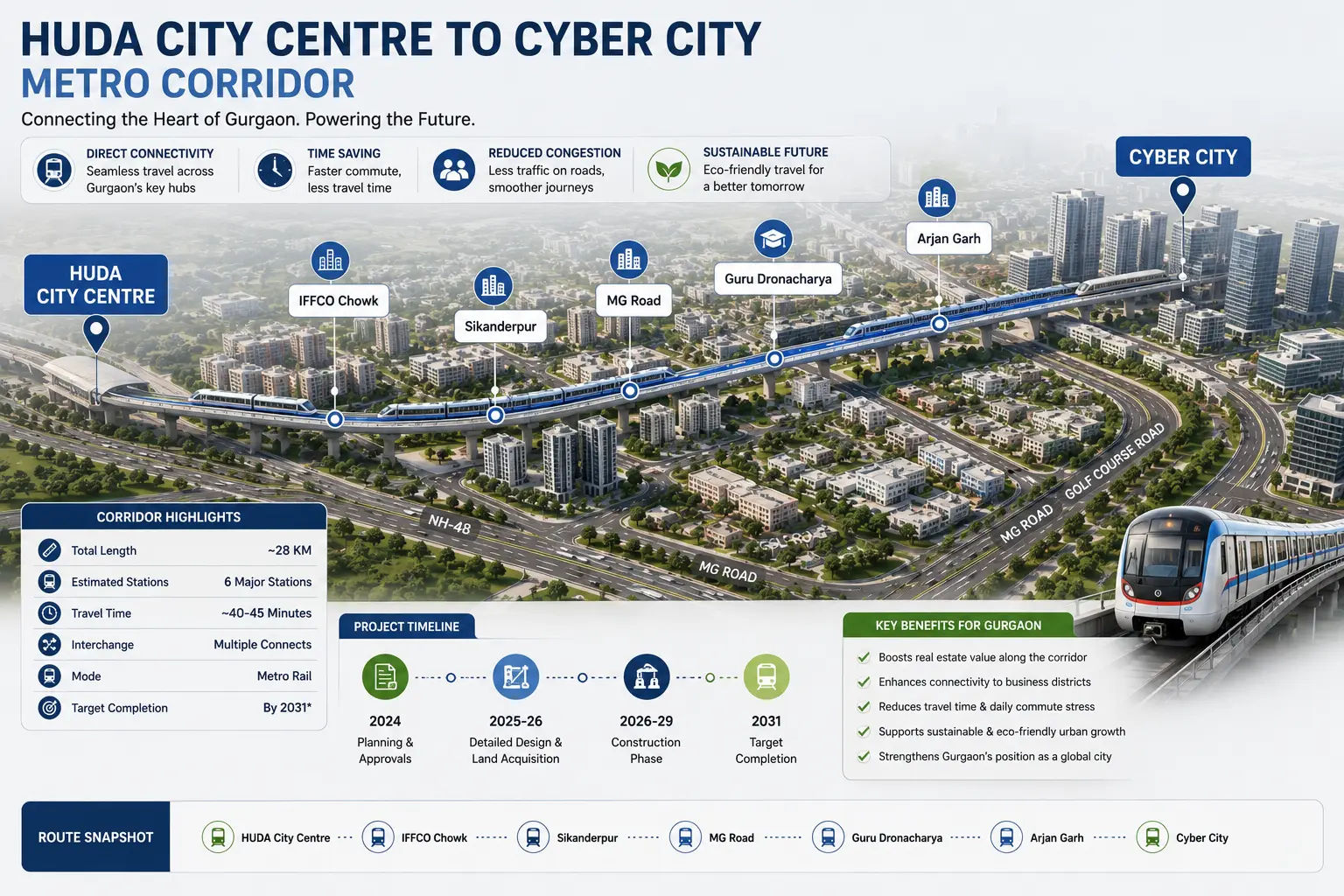
Connecting with existing Delhi Metro and Rapid Metro lines across Gurugram
What's Actually Being Built
The project is being executed by Gurgaon Metro Rail Limited (GMRL), a joint venture between the Central and Haryana governments operating under the Haryana Mass Transport Corporation's broader vision. The headline numbers:
28.5 km total length — a 26.65 km main loop plus a 1.85 km spur connecting Basai Village to Dwarka Expressway
27 elevated stations along the route
Over 2.5 million people expected to benefit directly
₹10,266 crore revised project cost, up from initial estimates due to design changes and delays
Six interchange stations, including links to Delhi Metro, Rapid Metro, and eventually RRTS
What makes this project genuinely different from past metro talk in Gurgaon is the loop design itself. Instead of a straight line connecting two points, it forms a full circuit linking Old Gurgaon and New Gurgaon — which means areas that have never had metro access in the city's history are finally getting it.
The Route: Old Gurgaon Finally Gets Its Turn
For years, the metro conversation in Gurgaon has been all about Cyber City, Golf Course Road, and the newer sectors. Old Gurgaon — densely populated, commercially active, but chronically underserved by mass transit — has largely been left out of that story.
This line flips that. Stations are planned across both halves of the city:
Old Gurgaon stretch brings metro access to areas like Sector 3, Sector 4, Sector 5, Sector 7, Sector 9, Ashok Vihar, Railway Station, Basai Village, Sector 37, Bus Stand, and Hero Honda Chowk — pockets of the city that have been functioning without any organized rail transit despite heavy daily footfall.
New Gurgaon stretch connects the already-thriving commercial corridor: Udyog Vihar (multiple phases), Sector 23A, Sector 22, IFFCO Chowk, HUDA City Centre, Sector 45, Cyber Park, Sector 47, Subhash Chowk, Sector 48, and Sector 72A — eventually meeting Cyber City and tying into the existing Rapid Metro network.
This isn't a vanity loop. It's stitching together two halves of Gurgaon that have effectively functioned as separate cities for two decades.
Why This Is a Big Deal for Real Estate, Not Just Commuters
Here's the part that should actually grab your attention if you're thinking property, not just public transport.
Metro connectivity has a well-documented pattern: prices near upcoming stations start moving well before the trains do, simply because access changes the calculus for both end-users and investors. Gurgaon is already showing early signs of exactly that pattern.
Sector 45, sitting close to the Millennium City Centre station, is currently averaging around ₹32,150 per sq. ft. for plots, with the locality already pulling buyers looking for well-connected residential options near commercial and educational hubs. With the metro line nearing completion, projected appreciation sits in the 30–40% range over five years.
Sector 47, near the upcoming Cyber Park station, is following a similar trajectory — current plot averages around ₹31,100 per sq. ft., with projected appreciation of 35–50% as connectivity firms up.
Sector 48, near Subhash Chowk station, is averaging around ₹27,800 per sq. ft. and seeing rising demand from both homebuyers and investors banking on improved access.
Sector 72A is arguably the most interesting story on this list — still relatively affordable at ₹7,222 to ₹8,888 per sq. ft., but tagged with the highest projected appreciation of the group: 40–60% as the project progresses. This is the kind of gap between current price and future potential that investors specifically hunt for.
Hero Honda Chowk is also drawing fresh investor attention, averaging around ₹6,666 per sq. ft., with the new station catalyzing both residential and commercial interest in the surrounding belt.
Udyog Vihar, long known as an industrial and office hub, is positioned for a commercial refresh — expect rising demand for office space, co-working setups, and retail as footfall through its new stations increases.
Palam Vihar and its extension, a mature, established locality, is seeing renewed buyer interest purely on the strength of upcoming metro access, with plot prices generally ranging between ₹10,000 and ₹21,000 per sq. ft.
Sectors 22 and 23A, sitting on the Dwarka Expressway corridor, benefit from a rare double advantage — expressway infrastructure stacked with incoming metro access, positioning them as strong residential bets.
Where Things Stand Right Now (June 2026 Update)
This isn't a paper project anymore — there's visible movement on the ground:
The project cost has been revised upward to ₹10,266 crore, reflecting both design enhancements and the inevitable delays that come with infrastructure projects of this scale.
Site clearance work is actively underway, including the relocation of major power lines near Millennium City Centre to make way for track construction — usually one of the more reliable signs that a project has moved past the planning stage into real execution.
There's been direct ministerial intervention pushing against further delays, which signals this has political priority attached to it now, not just bureaucratic momentum.
Phase II surveys have already started, scoping an extension deeper into Old Gurgaon covering Sectors 3, 4, 5, 7, and Ashok Vihar — areas that, if this materializes, could see the kind of early-mover price advantage that Sector 72A and Hero Honda Chowk are seeing right now.
The Investor's Lens: How to Actually Use This Information
The pattern across almost every Indian city with metro expansion is consistent: prices closer to confirmed, funded, under-construction stations move first and move fastest, while areas still in the "survey" or "proposed" stage carry more risk but also more upside if the project actually lands.
Right now, that puts Gurgaon's localities into three rough buckets:
Already pricing in the metro — Sector 45, 47, 48, and Palam Vihar are mature enough that the metro premium is partially baked into current rates. Expect steady, lower-risk appreciation.
Catching the wave mid-construction — Sector 72A, Hero Honda Chowk, and the Sector 22/23A Dwarka Expressway pocket sit at a sweeter entry point, with construction underway but prices not yet fully adjusted.
Speculative but high-potential — the Phase II survey areas (Sectors 3, 4, 5, 7, Ashok Vihar) are the highest-risk, highest-reward play. Nothing's confirmed yet, but early entrants into genuinely transformative infrastructure projects have historically captured the largest gains — provided the project actually gets built on schedule.
Conclusion
This metro line is doing something Gurgaon's real estate market has needed for years: connecting its oldest, most underserved neighborhoods to its newest, most expensive ones. That kind of structural shift doesn't happen often, and when it does, it tends to reshuffle which sectors are considered "prime" for the next decade.
Whether you're an end-user tired of the daily Gurgaon commute or an investor looking for the next growth corridor before everyone else notices it, this is exactly the kind of infrastructure development worth tracking closely — not after the trains start running, but while the tracks are still being laid.