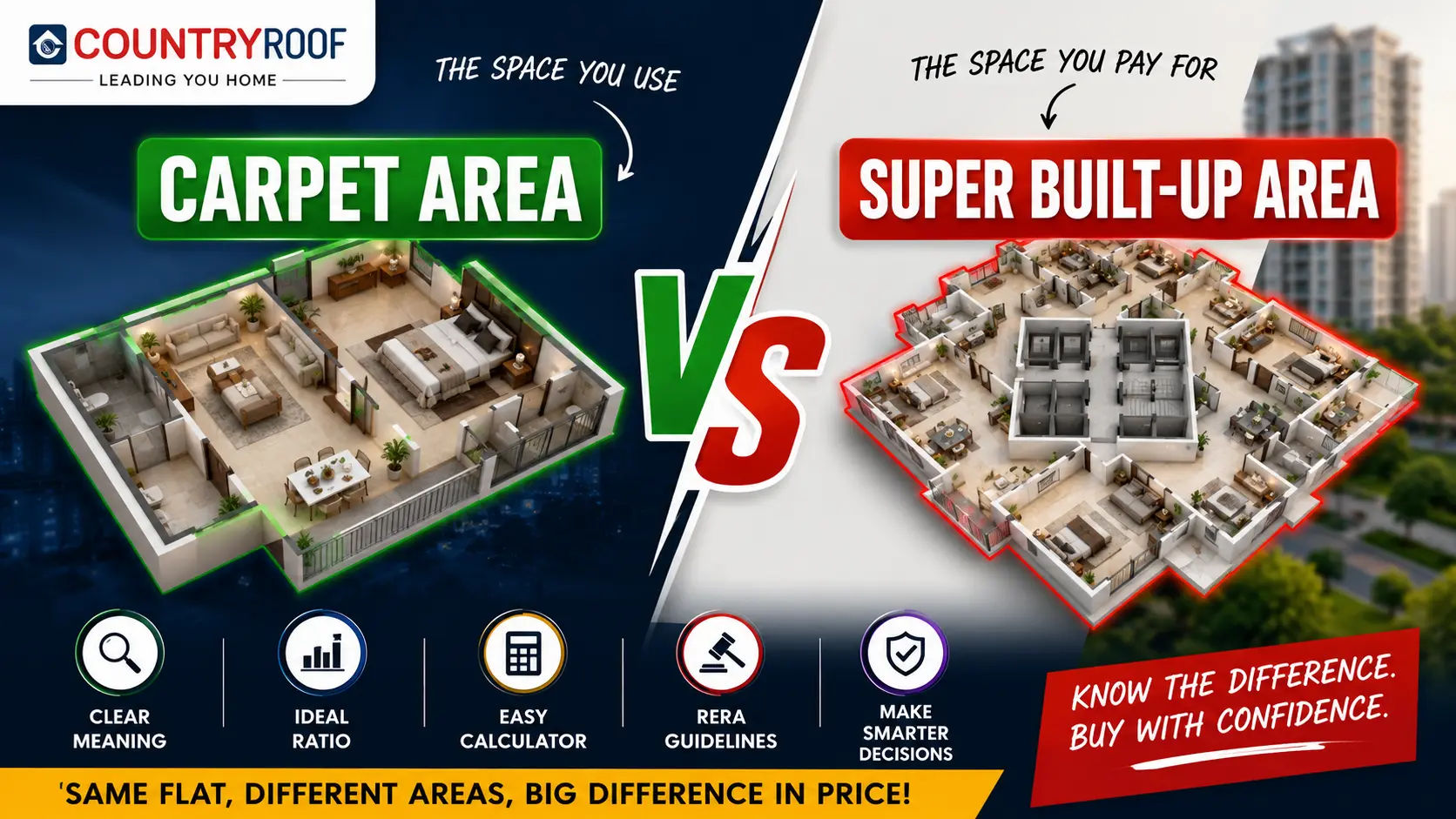
When buying a flat, the advertised size is often not the actual space you'll use every day. Builders typically promote apartments based on super built-up area, while the actual living space inside your home is measured as carpet area.
This difference can significantly affect the value you receive, the effective price per square foot, and how two properties compare against each other.
Carpet Area vs Super Built-Up Area: Quick Answer
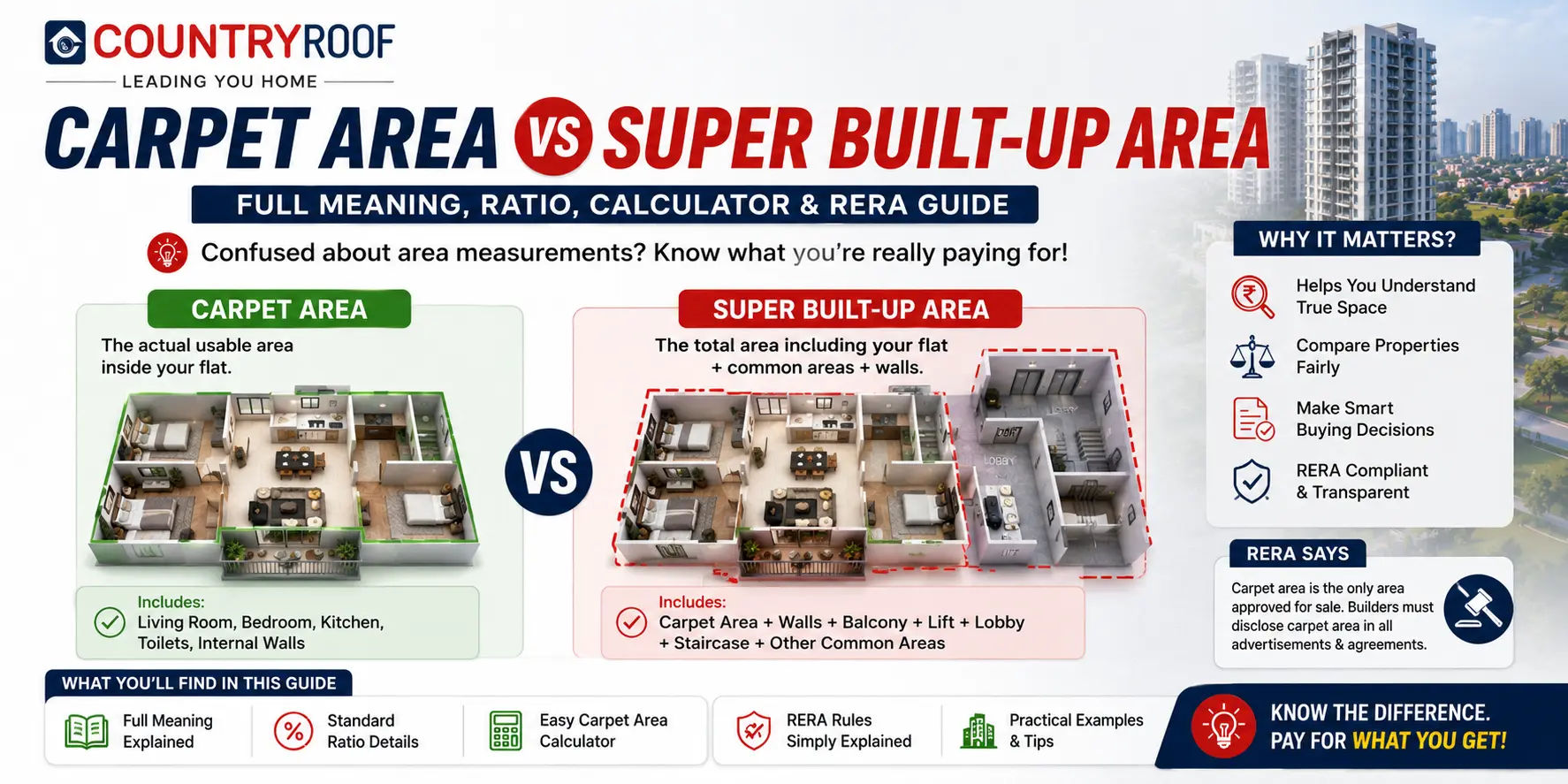
When buying a flat, the advertised size is often not the actual usable space you get. Builders usually market apartments based on super built-up area, while the actual usable space inside your home is measured as carpet area.
This difference affects the real value of the property, the effective price per square foot, and how different flats should be compared.
Area Comparison
Area Type | What It Includes |
|---|---|
Carpet Area | Actual usable space inside the flat, including rooms, kitchen, bathrooms, and internal walls |
Built-Up Area | Carpet area + wall thickness + balcony/verandah |
Super Built-Up Area | Built-up area + proportionate share of common areas like lifts, corridors, lobbies, staircases, clubhouse, and amenities |
Which Area Matters Most?
Carpet area matters the most for homebuyers because it represents the actual usable space inside your home.
It is also the only area definition legally recognised under the RERA Act for sale agreements.
How Much Area Will You Actually Get?
A flat advertised as 1,500 sq ft super built-up area typically provides only 1,050–1,150 sq ft carpet area, depending on the project’s loading factor.
Quick Rule for Buyers
✔ Always ask for RERA carpet area
✔ Compare flats using carpet area, not super built-up area
✔ Check the loading factor before booking
✔ Prefer a carpet area efficiency ratio above 70%
What You Will Learn in This Guide
In this guide, you’ll understand:
Difference between carpet, built-up, and super built-up area
How the loading factor works in apartments
How to calculate actual usable space
RERA rules every homebuyer must know
How to compare flats correctly before buying
Key Takeaways
Carpet area is the actual usable space inside your apartment.
Built-up area includes carpet area plus wall thickness and balconies.
Super built-up area includes built-up area plus a share of common facilities.
Builders usually quote prices based on super built-up area.
RERA requires developers to disclose carpet area.
A loading factor between 25% and 35% is generally considered normal.
A carpet area efficiency ratio above 70% is considered good.
Always compare projects using cost per carpet sq ft, not cost per super built-up sq ft.
1. What Is Carpet Area? (RERA Definition & Meaning)
Carpet area is exactly what the name suggests — the area where you can actually lay a carpet. It is the net usable floor area inside your flat's walls, measured from the inner edge of one wall to the inner edge of the opposite wall.
Under the Real Estate (Regulation and Development) Act, 2016, the legal definition is:
RERA Definition (Section 2(k)): "Carpet area means the net usable floor area of an apartment, excluding the area covered by the external walls, areas under services shafts, exclusive balcony or verandah area and exclusive open terrace area, but includes the area covered by the internal partition walls of the apartment."
In simple terms, carpet area includes:
Bedrooms, living room, dining area
Kitchen
Bathrooms and toilets
Internal walls (partition walls between rooms)
Internal corridor or passage within the flat
Carpet area excludes:
External walls (the thickness of the outer boundary walls)
Balcony or verandah (counted separately)
Open terrace
Service shafts (electrical/plumbing ducts)
Note on balconies: Many builders add balcony area to carpet area in their brochures. Under RERA, balcony is excluded from carpet area and must be shown separately. Always check the RERA disclosure document, not the brochure.
2. What Is Super Built-Up Area?
Super built-up area (also called saleable area) is the carpet area of your flat plus your proportionate share of all common areas in the building. This includes spaces you share with every other resident — the lobby, staircases, lift shafts, corridors on each floor, security cabin, generator room, clubhouse, and sometimes even the amenity areas.
Every flat in the building contributes a share of these common areas, calculated proportionally based on your flat's size relative to the total project. The larger your flat, the larger your share of common areas.
Key point: Super built-up area is a marketing and pricing tool. It is not a legal area definition under RERA. Builders price their flats on super built-up area because it inflates the quoted size and allows a lower stated price per sq ft — while you're actually paying for space you can never use exclusively.
What Does "Loading" Mean Here?
The extra area added over carpet area to arrive at super built-up area is called the loading factor. This is explained in the next section. For now, remember: the higher the loading, the more you're paying for common areas rather than your actual living space.
3. Carpet Area vs Super Built-Up Area: Simple Comparison
Parameter | Carpet Area | Built-Up Area | Super Built-Up Area |
|---|---|---|---|
Definition | Usable area inside walls | Carpet + external wall thickness | Built-up + proportionate common areas |
Usability | 100% usable by you | ~90–95% usable | Only carpet area is truly usable |
Includes | Rooms, kitchen, bathrooms, internal walls | Carpet + outer walls + balcony | Built-up + lobby, lifts, stairs, amenities (shared) |
RERA mandated | ✅ Yes — must be disclosed | ❌ No legal requirement | ❌ Not a legal area term under RERA |
Used for pricing | Rarely (should be) | Sometimes | Yes, most commonly by builders |
Transparency | High | Medium | Low — varies by project |
Resale comparison | Best metric | Useful | Misleading across projects |
Typical size vs carpet | Base (100%) | ~110–115% of carpet | ~125–150% of carpet |
What is Loading Factor in Apartments?
The loading factor is the percentage of extra area added to your carpet area to arrive at the super built-up area. It represents your proportionate share of all common areas in the building.
Think of it this way: if a building has 100 flats, all the lobbies, staircases, lift shafts, and amenity areas have to be "distributed" among those 100 flats. Each flat absorbs a share. That share — expressed as a percentage of carpet area — is the loading factor.
Loading Factor Formula
Super Built-Up Area = Carpet Area × (1 + Loading Factor)
Or to find Loading Factor:
Loading Factor = (Super Built-Up Area − Carpet Area) ÷ Carpet Area × 100
loading percentage Range — What's Normal?
Loading Percentage | What It Means | Verdict |
|---|---|---|
20–25% | Minimal common areas, efficient design | ✅ Excellent |
25–35% | Standard for most good residential projects | ✅ Normal / Acceptable |
35–45% | Larger lobbies, more amenities — check if justified | ⚠️ High |
45%+ | Aggressive loading — you're paying for a lot of space you don't control | ❌ Avoid if possible |
Builder trick to watch for: Some builders include even the external amenity land area, clubhouse square footage, and landscaping in the loading calculation. This pushes loading to 50%+, which means nearly half of what you're paying for is space shared with hundreds of other residents.
Questions to Ask a Builder Before Booking a Flat
Before paying a booking amount or signing any agreement, ask these questions to understand the actual space you're buying and avoid surprises later.
1. What Is the RERA Carpet Area?
Ask for the carpet area mentioned in the project's RERA registration. This is the legally recognised usable area of the apartment and the most important number for comparison.
2. What Is the Loading Factor?
Most builders advertise the super built-up area but do not highlight the loading percentage. Knowing the loading percentage helps you understand how much of the advertised area is actually usable.
3. What Common Areas Are Included in the Loading?
Ask whether the loading includes:
Lobbies
Corridors
Staircases
Lift areas
Clubhouse
Swimming pool
Landscaped areas
Two projects can have the same common area share but offer very different value depending on what is included.
4. Is Balcony Area Included Separately?
Under RERA, balconies and terraces should be shown separately from carpet area. Always verify how the builder has calculated the area.
5. What Is the Carpet Area Efficiency Ratio?
The efficiency ratio shows how much usable space you actually receive.
Efficiency Ratio = Carpet Area ÷ Super Built-Up Area × 100
A ratio above 70% is generally considered efficient.
6. What Is the Effective Cost Per Carpet Sq Ft?
Do not rely only on the advertised rate per sq ft.
Calculate:
Effective Cost Per Carpet Sq Ft = Total Apartment Cost ÷ Carpet Area
This gives the true price of the usable space you are buying.
Quick Checklist Before Booking
✅ Verify carpet area from RERA
✅ Check loading factor
✅ Compare efficiency ratio
✅ Calculate cost per carpet sq ft
✅ Understand what is included in common areas
These five checks can help you compare projects more accurately and avoid overpaying for shared spaces.
5. Carpet Area Efficiency Ratio: What Is a Good Carpet Area Ratio?
The efficiency ratio tells you what percentage of the super built-up area you actually get to use. It's the most honest single number to compare two projects.
Efficiency Ratio = (Carpet Area ÷ Super Built-Up Area) × 100
Here's how to interpret it:
70%+
Good efficiency
Loading ≤ 30%
Most of your money goes to usable space
60–70%
Average efficiency
Loading 30–45%
Acceptable if amenities justify it
<60%
Poor efficiency
Loading 45%+
Significant overpayment for common areas
💡 Practical tip: When comparing two flats — say one at ₹8,000/sq ft (super built-up) with 65% efficiency vs another at ₹9,000/sq ft with 75% efficiency — the second flat is actually cheaper on a usable-space basis. Always convert to cost per carpet sq ft before comparing.
6. Carpet Area vs Super Built-Up Area Percentage — Step by Step
Let's work through a real calculation so this becomes concrete.
Given Numbers
Carpet Area: 1,000 sq ft
Super Built-Up Area: 1,350 sq ft
Step 1: Calculate Loading Factor
Loading Factor = (1350 − 1000) ÷ 1000 × 100
= 350 ÷ 1000 × 100
= 35%
Step 2: Calculate Efficiency Ratio
Efficiency = (1000 ÷ 1350) × 100
= 74.07% ≈ 74%
Step 3: Price Per Usable Sq Ft
If the builder is quoting ₹9,000/sq ft on super built-up area:
Total flat cost = 1350 × ₹9,000 = ₹1,21,50,000
Effective cost per carpet sq ft = ₹1,21,50,000 ÷ 1000 = ₹12,150/sq ft
You're actually paying ₹12,150/sq ft for usable space, not ₹9,000. This is the pricing illusion that super built-up area creates.
7. Carpet Area Calculator Formula & Super Built-Up Area Calculation
There are two ways to calculate super built-up area, depending on what data you have.
Method 1: If You Know the Loading Factor
Super Built-Up Area = Carpet Area × (1 + Loading Factor / 100)
Example: 900 × (1 + 30/100) = 900 × 1.30 = 1,170 sq ft
Method 2: If You Know the Common Area Share
Super Built-Up Area = Carpet Area + Built-Up Area's wall thickness + Common Area Share
OR simplified:
Super Built-Up = Built-Up Area + Proportionate Common Area
Method 3: Reverse Calculate Carpet from SBA
Carpet Area = Super Built-Up Area ÷ (1 + Loading Factor / 100)
Example: 1,350 ÷ 1.35 = 1,000 sq ft
Most builders don't openly disclose the loading factor. Always ask: "What is the carpet area as per RERA?" — they are legally required to tell you. Then divide by the super built-up area to calculate the loading yourself.
8. Carpet Area vs Built-Up Area vs Super Built-Up Area: Complete Comparison
Here's the complete breakdown of all four area terms used in Indian real estate — ranked from smallest to largest:
Area Type | What It Includes | Approx. Size vs Carpet | RERA Status |
|---|---|---|---|
Carpet Area | Usable space inside walls — rooms, kitchen, bathrooms, internal walls | Base (100%) | ✅ Legally defined |
Built-Up Area | Carpet area + external wall thickness + balcony + dry terrace | ~110–115% | ❌ Not in RERA |
Super Built-Up Area | Built-up area + proportionate share of common areas (lobby, lifts, stairs, amenities) | ~125–150% | ❌ Marketing term |
Covered Area | Sometimes used interchangeably with built-up, or refers to area under the roof only (varies by builder) | ~110–120% | ❌ No standard definition |
"Covered area" has no standardised definition in Indian real estate. Different builders use it differently — sometimes as built-up area, sometimes as super built-up. Always ask the builder to define it specifically and cross-check with the RERA filing.
9. RERA Rules on Carpet Area: What the Law Actually Says
The RERA Act of 2016 was specifically designed to end the confusion around area definitions. Here's what it mandates:
What RERA Requires
Carpet area must be disclosed for every flat in every RERA-registered project
Builders must mention carpet area (not super built-up area) in the sale agreement
If the delivered carpet area is less than what was agreed, the buyer is entitled to a refund proportionate to the shortfall
Balcony and open terrace areas must be shown separately, not clubbed with the carpet area
What RERA Does NOT Do
RERA does not ban pricing on super built-up area — builders can still quote SBA in ads
RERA does not define "loading factor" or cap it
RERA does not regulate what goes into the common area calculation
The loophole: Builders advertise in super built-up areas (legal) but are required to register the sale on carpet area (also legal). This means you may book a "1,350 sq ft" flat and sign a sale agreement for "1,000 sq ft" — and both figures are technically correct. The difference is the loading.
How to Verify via RERA
Every RERA-registered project must upload floor plans and carpet area details on the state RERA portal. For Haryana projects, check HRERA. Search by project name and look for the "carpet area" column against each flat type — this is your legal reference number.
Carpet Area vs Super Built-Up Area in Gurgaon Projects
Typical Loading Factor in Gurgaon Projects
The area loading in Gurgaon can vary significantly depending on the location, project category, and amenities offered. While there is no fixed industry standard, understanding the typical range can help buyers compare projects more effectively.
Location / Project Type | Typical Loading Percentage |
|---|---|
Dwarka Expressway Projects | 25%–40% |
SPR (Southern Peripheral Road) Projects | 25%–38% |
Golf Course Extension Road Projects | 30%–45% |
Luxury Residential Projects | 35%–50%+ |
Mid-Segment Residential Projects | 20%–35% |
Dwarka Expressway Projects
Many new launch projects on Dwarka Expressway offer large clubhouses, landscaped greens, sports facilities, and multiple towers. While these amenities improve the lifestyle experience, they can also increase the cost of the common area share.
Before booking, compare the RERA carpet area instead of relying solely on the advertised super built-up area.
SPR Road Projects
Residential projects along Southern Peripheral Road (SPR) generally maintain moderate loading levels, especially in mid-segment developments. However, premium projects with extensive amenities may have higher loading percentages.
Buyers should calculate the carpet area efficiency ratio before comparing prices between projects.
Golf Course Extension Road Projects
Golf Course Extension Road is home to many luxury residential developments. These projects often feature larger lobbies, premium clubhouses, concierge services, sky decks, and extensive common facilities.
As a result, loading factors may be higher than those found in standard residential developments. A higher loading factor is not necessarily negative if the amenities justify the additional cost.
Luxury vs Mid-Segment Projects
A luxury project with a 40% loading factor may still offer better overall value if it includes premium facilities and superior infrastructure. However, buyers should always compare:
RERA carpet area
Carpet area efficiency ratio
Effective cost per carpet sq ft
Rather than comparing only the advertised super built-up area.
Expert Tip for Gurgaon Homebuyers
When comparing apartments in Gurgaon, don't focus only on the quoted price per sq ft. Two flats with the same super built-up area can have very different carpet areas depending on the project's loading factor.
Always compare projects based on usable carpet area and effective cost per carpet sq ft to understand the true value of your investment.
10. Real-Life Examples: Carpet Area vs Super Built-Up Area with Numbers
Scenario 1 — 2 BHK Flat in Gurgaon
Advertised size | 1,250 sq ft (super built-up) |
Carpet area (RERA) | 875 sq ft |
Loading factor | (1250−875) ÷ 875 × 100 = 42.8% |
Efficiency ratio | 875 ÷ 1250 × 100 = 70% |
Quoted price | ₹7,500/sq ft on super built-up |
Total cost | ₹93.75 lakh |
Effective cost per usable sq ft | ₹93.75L ÷ 875 = ₹10,714/sq ft |
The builder quoted ₹7,500/sq ft. But you're actually paying ₹10,714 per square foot of space you can use. The 42.8% loading is on the higher end and should be questioned before booking.
Scenario 2 — Comparing Two Projects Side by Side
Parameter | Project A | Project B |
|---|---|---|
Super built-up area | 1,400 sq ft | 1,400 sq ft |
Carpet area (RERA) | 980 sq ft | 840 sq ft |
Loading factor | 42.8% | 66.7% |
Efficiency ratio | 70% | 60% |
Quoted price/sq ft (SBA) | ₹8,000 | ₹7,000 |
Total cost | ₹1.12 Cr | ₹98 lakh |
Effective cost/carpet sq ft | ₹11,428 | ₹11,666 |
Project B looks cheaper at ₹7,000/sq ft vs Project A's ₹8,000. But on a carpet area basis, Project A gives you 980 sq ft of usable space for ₹11,428/sq ft, while Project B gives only 840 sq ft for ₹11,666/sq ft. Project A is actually the better deal — and you'd only know this by comparing carpet areas.
Scenario 3 — Ready-to-Move 3 BHK in Delhi NCR
Advertised area | 1,800 sq ft (super built-up) |
Carpet area | 1,260 sq ft |
Loading factor | 42.8% |
Efficiency | 70% |
Monthly rent potential | ₹45,000/month |
Rental yield basis | Always calculated on total cost, not carpet area |
Even for rental evaluation, always check carpet area — tenants care about actual usable space. A 1,260 sq ft carpet area 3 BHK rents for more than a 1,260 sq ft carpet area 2 BHK, regardless of what super built-up area the builder claims.
11. Carpet Area Calculator: Convert Super Built-Up to Carpet Area
Use this tool to find out how much usable space you're actually getting, and what you're paying per carpet sq ft.
Carpet Area & Efficiency Calculator
Super Built-Up Area (sq ft)
Loading Factor (%)
Price per sq ft (SBA basis) ₹
Calculate
12. Which Area Should You Use When Buying a Flat?
This becomes even more important when comparing 3 BHK flats in Gurgaon across different developers. Two apartments may have the same advertised super built-up area but offer significantly different carpet areas and loading factors.
Always Compare on Carpet Area
When you're comparing two flats — from different builders, in different projects, or even in the same project — use carpet area. It's the only consistent, legally defined, apples-to-apples number.
Use Super Built-Up Area Only to Calculate Total Cost
Since builders price on super built-up area, you'll need it to calculate how much you owe. But the moment you want to compare value, convert everything to cost per carpet sq ft.
For EMI Planning
Your EMI is based on the total loan amount — which is derived from the total flat cost (i.e., SBA × price per sq ft + extras). So SBA matters for budget calculations. But when comparing EMI-to-value across projects, always factor in what carpet area you're getting for that EMI.
Decision | Use This | Why |
|---|---|---|
Comparing flat sizes | Carpet Area | Only consistent, legally verified number |
Comparing value for money | Cost per Carpet sq ft | Reveals true price of usable space |
Calculating total cost / EMI | Super Built-Up Area | Builders price on SBA — needed for total outflow |
Comparing rental income potential | Carpet Area | Tenants pay for usable space |
Resale value comparison | Carpet Area | Post-RERA, resale is increasingly carpet-area driven |
The Simple Rule
Always ask for RERA carpet area — it's your legal right
Calculate efficiency ratio = carpet ÷ SBA × 100; aim for 70%+
Calculate effective cost = total price ÷ carpet area
Compare projects on this effective cost per carpet sq ft — not on the advertised price per SBA
A lower advertised rate does not mean better value if loading is higher
CountryRoof Expert Tip
In Gurgaon, loading factors can vary significantly from one project to another, especially across luxury developments on Dwarka Expressway, Golf Course Extension Road, and SPR. Two apartments with the same advertised super built-up area may offer very different carpet areas. Before comparing prices, calculate the carpet area efficiency ratio and the effective cost per carpet sq ft. This gives a far more accurate picture of value for money than relying on the builder's advertised rate.
Common Mistakes Buyers Make Around Carpet Area
Comparing flats on super built-up area alone, a 1,400 sq ft flat in Project A and a 1,400 sq ft flat in Project B can have carpet areas of 980 sq ft and 840 sq ft respectively. Comparing to SBA gives you a false sense of equivalence.
Trusting brochure area figures without RERA verification Brochures are marketing material. The legally binding carpet area figure is in the RERA filing. Always cross-check at the state RERA portal.
Ignoring loading factor during builder negotiation Builders rarely volunteer the loading percentage. Buyers who don't ask end up discovering the true usable area only after possession — when it's too late to renegotiate.
Including balcony area as part of carpet area. Under RERA, balcony area is shown separately. Some builders (especially pre-RERA projects or unregistered ones) club it in, making the flat seem larger than it legally is.
Comparing prices per sq ft across projects without normalising for loading ₹8,000/sq ft with 30% loading = ₹10,400/carpet sq ft. ₹9,500/sq ft with 20% loading = ₹11,400/carpet sq ft. The first project is actually cheaper on a usable-space basis, but most buyers would never calculate this.
Not asking what's included in "common areas" for loading Some builders count only lobby and stairs. Others add clubhouse, parking, swimming pool area, and landscaping. A loading of 40% from two different builders can mean very different things depending on what's included.
Final Verdict: Carpet Area vs Super Built-Up Area
If you're comparing flats, carpet area is the only number that truly matters for value comparison because it represents the actual usable space inside your home.
Super built-up area is useful only for understanding total pricing, but it includes shared spaces that you do not exclusively own or use.
Before booking any flat, always:
Verify the RERA carpet area
Compare properties using cost per carpet sq ft
Check the loading factor
Ensure the carpet area efficiency ratio is 70% or higher
In most cases, a flat with a higher carpet area (even at a higher price per sq ft) offers better real value than a larger-looking super built-up area unit.
Simple rule:
If you cannot compare carpet area, you are not comparing real value.
Conclusion
Understanding the difference between carpet area, built-up area, and super built-up area is essential for every homebuyer.
While super built-up area is commonly used for pricing, it does not represent the actual usable space inside your home.
Carpet area gives a true picture of the space you will live in, and it should always be your primary comparison metric when evaluating properties.
Before making a purchase, always verify RERA carpet area, check the loading factor, and compare cost per carpet square foot to ensure you are making a well-informed decision.
A clear understanding of these terms can help you avoid overpaying and choose the right property with better value and transparency.