Let's be honest about something most real estate blogs won't tell you.
When people search for "affordable projects on Dwarka Expressway," they're not just looking for cheap flats. They're asking a deeper question: Can I find a home here that fits my budget today — and still makes financial sense five years from now?
That's a harder question to answer, and it deserves a more honest, nuanced response than the usual "prices are booming, invest now!" content you'll find everywhere else.
So let's get into it — with real data, realistic expectations, and the kind of ground-level insight that actually helps you make a decision.
Why Dwarka Expressway Still Makes Sense for Budget-Conscious Buyers in 2026
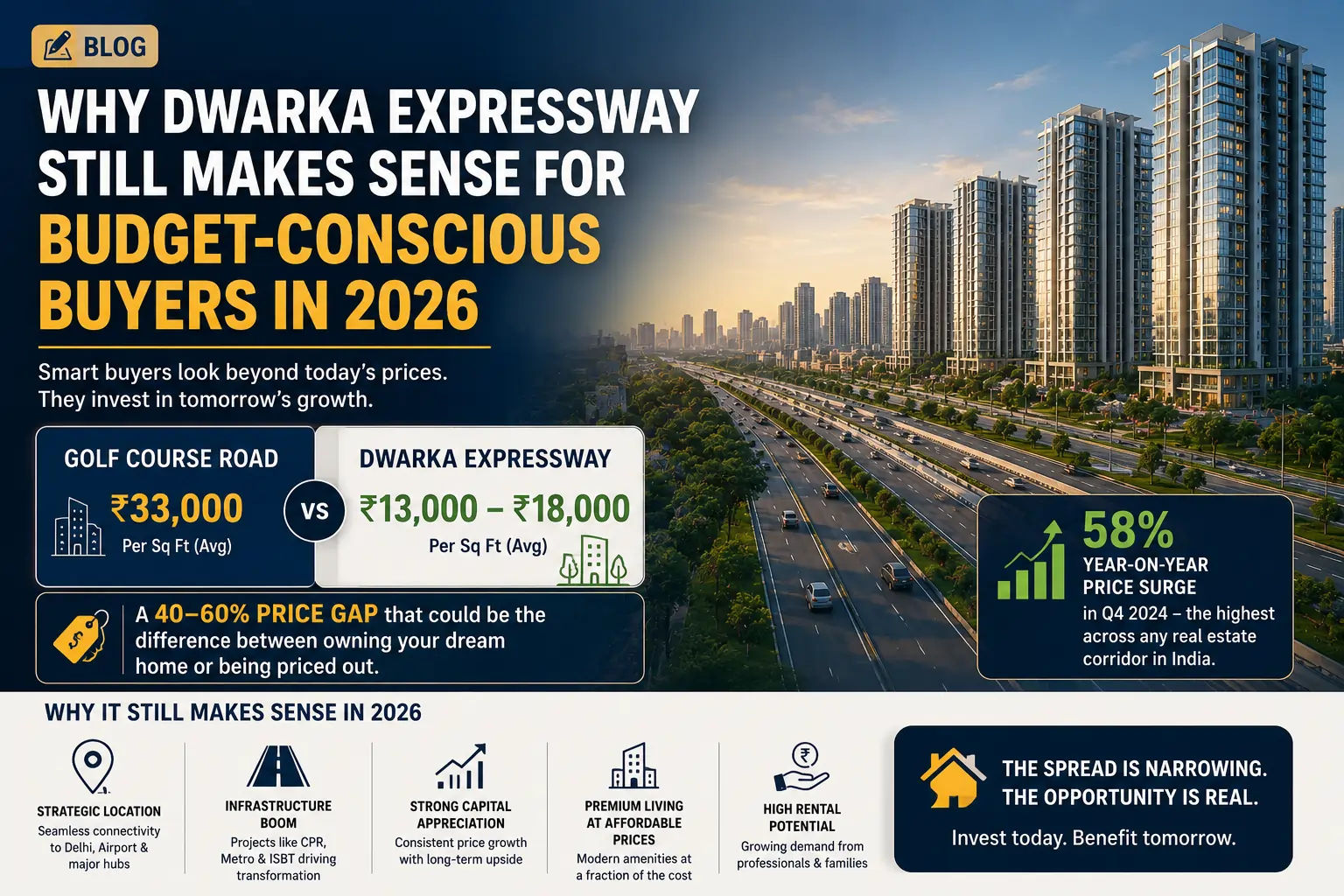
Here's a number that should give you perspective: Golf Course Road in Gurgaon currently trades at around ₹33,000 per sq ft. Dwarka Expressway? Despite a massive price run-up, the average still hovers between ₹13,000 and ₹18,000 per sq ft, depending on the sector and project.
That's a 40–60% pricing gap between two corridors that are both within Gurgaon, both well-connected, and both considered premium by Delhi-NCR standards.
For someone working with a budget of ₹80 lakhs to ₹1.5 crores, that gap is the difference between owning a well-located home in one of India's fastest-growing corridors — or being priced out entirely.
The expressway has already delivered a 58% year-on-year price surge in Q4 2024, the highest recorded across any single real estate corridor in India during that period. But the spread compression story — the gradual narrowing of that ₹5,000–₹8,000 per sq ft gap with established Gurgaon zones — is still playing out. That's where the long-term opportunity for today's buyer sits.
The Expressway Is No Longer "Coming Soon" — It's Here
One of the biggest reasons people hesitated to invest in Dwarka Expressway for nearly a decade was simple: the infrastructure wasn't ready. The road was perpetually under construction. Sectors were underdeveloped. And promises of metro connectivity kept getting pushed.
That story is over.
The 27.6 km stretch connecting Shiv Murti in Delhi to Kherki Daula in Gurugram is now fully operational. Travel times have collapsed. Commuting to IGI Airport — one of the key drivers of demand in this corridor — now takes minutes rather than an hour.
More importantly, the social infrastructure is catching up. Reputed schools, multi-speciality hospitals, retail centres, and lifestyle amenities are no longer "planned" — they're operational. This transformation from a transit corridor to a self-sustaining urban ecosystem is precisely what separates today's Dwarka Expressway from what it was in 2018.
And the metro? A 15.2 km corridor connecting Millennium City Centre to Cyber City, with a spur toward Dwarka Expressway, is underway — projected for commissioning around 2027. When that connectivity lands, another repricing event becomes almost inevitable.
Where Are the Genuinely Affordable Pockets? A Sector-by-Sector Breakdown
Not all of Dwarka Expressway is the same market. Treating it as a single zone is, as one institutional analyst put it, "a capital error." Here's what you actually need to know:
Sectors 99–102: The Budget Sweet Spot
If you're working with a budget under ₹1 crore, Sectors 99–102 offer the most accessible entry points on the entire corridor. You can find 2BHK and 3BHK options starting around ₹80 lakhs here — in RERA-registered, gated communities with standard amenities.
The trade-off? These sectors are slightly away from the Delhi border and don't command the airport proximity premium. But for a family prioritising spacious living, schools, and a gated community environment without stretching finances, this is where value genuinely exists.
Sector 37D and 36A: Affordable with Appreciation Upside
Both sectors have seen developers focus on mid-income housing, with projects by Signature Global and others targeting the ₹50 lakh–₹1.2 crore range. Signature Global's presence here is notable — the company has a robust pipeline of 6.4 million sq ft of saleable area in this location, which signals long-term commitment, not just opportunistic launches.
Quick appreciation potential here is real, precisely because prices haven't yet caught up with the expressway premium the way Sectors 109–113 have.
Sectors 104–109: Mid-Range with Strong Rental Demand
Gated communities in this belt — many from developers like Godrej, Sobha, and Tata — offer 2BHK options in the ₹1 crore–₹1.5 crore range. These aren't the cheapest entry points, but they're the ones with the most active rental markets right now, driven by airport proximity and proximity to commercial hubs.
For investors specifically interested in rental income alongside appreciation, this belt deserves serious consideration. Rental yields in this zone are estimated at 2.5%–3.2%, which won't replace equity returns but provides a useful income buffer.
Sectors 113–114: The "Spread Compression" Play
For buyers who can stretch to ₹1.5–₹2.5 crore, the border sectors offer what institutional investors are calling the most compelling thesis on the corridor: the narrowing gap between Dwarka Expressway pricing and established premium Gurgaon corridors. These sectors have seen 40–60% inventory absorption in initial phases of premium launches, which tells you something real about demand quality.
The Real Appreciation Story: What the Numbers Actually Say
Let's put the price journey in context:
2010: ₹2,500 per sq ft
2019: ₹5,360 per sq ft
2021: ₹5,700 per sq ft
2024: ₹18,668 per sq ft (new launches in premium sectors)
2025 average: ₹13,300–₹18,000 per sq ft, depending on sector
That's a 5x increase over 15 years, with a particularly sharp acceleration in the last four years as infrastructure moved from announced to operational.
What's the forward outlook? Experts across JLL India, Knight Frank, and PropEquity are broadly aligned: another 15–20% price increase is possible by 2026, with a 40–60% long-term appreciation by 2030 from current levels. Between now and 2030, over 18,000 units are expected to be launched — and over 15,500 units are expected to be absorbed. That's a supply-demand ratio that continues to favour price support.
But here's the honest nuance: not every project will participate equally in this appreciation. Some projects in the corridor have seen near-stagnant prices even post-possession. Builder selection, possession timeline, and sector-specific supply density matter enormously.
What Families Actually Get for Their Money Here
Beyond the investment calculus, Dwarka Expressway has become a genuinely liveable place — and that matters if you're actually going to live there rather than just trade the asset.
Educational Infrastructure: The corridor now hosts campuses of reputed school chains that have historically operated in South Delhi and Golf Course Road zones. For families with children, this was always the missing piece. It's no longer missing.
Healthcare Access: Multi-speciality hospital infrastructure has expanded significantly. Proximity to Medanta in the broader Gurgaon belt, combined with newer clinics and diagnostic centres within the corridor itself, means healthcare access is no longer a compromise.
Weekend Living: The emergence of malls, entertainment hubs, restaurants, and lifestyle zones along the expressway has created a weekend quality of life that early residents here simply didn't have. This soft infrastructure matters for families deciding whether to actually live somewhere.
Green Spaces: Several large-format residential projects along the corridor have been designed with green zones, jogging tracks, and open areas that high-density South Delhi or central Gurgaon simply can't match at comparable price points. If space — physical, breathing space — matters to your family, this corridor delivers it.
The Airport Advantage: Underrated by Most Buyers
Here's something families and professionals both underestimate: living within 15–20 minutes of IGI Airport is a genuine quality-of-life upgrade.
If you travel for work even twice a month, the mental arithmetic of "airport runs" — the late-night returns, the early departures, the taxi costs from Faridabad or East Delhi — adds up to real time and real money. Dwarka Expressway's proximity to the airport isn't just a bullet point in a developer brochure. It's a daily-life advantage that residents consistently cite as one of the most underrated benefits of choosing this corridor.
For NRIs evaluating property in India, this proximity is even more directly relevant.
The Honest Risk Assessment: What to Watch Out For
A responsible real estate article in 2026 should include this section — and most don't.
Project Selection Matters More Than Corridor Selection
The most important insight from recent data is this: Dwarka Expressway as a corridor has done well, but individual project performance varies significantly. Some ready-to-move projects from reputed builders have delivered barely 1.5% annual appreciation in recent years. Others have tripled. The difference comes down to sector, possession status, developer credibility, and community quality.
Do not assume that "Dwarka Expressway" is a guarantee of appreciation. It is a favourable environment — not an automatic outcome.
Under-Construction Risk Is Real
Several projects from the earlier development wave were delayed by years. While RERA has significantly improved developer accountability, it hasn't eliminated delivery risk. For buyers entering under-construction projects, prioritise builders with a clear track record of on-time delivery. Check RERA registration numbers, quarterly completion updates, and escrow compliance before signing.
Supply Density in Mid-Segments
Some mid-range sectors have seen heavy supply additions. Rental yield compression is a real risk in zones where supply outpaces absorption. If rental income is part of your investment thesis, sector-specific supply assessment is non-negotiable.
Developer Landscape: Who's Building What for Whom
Understanding which developers are active in the affordable-to-mid segment is a useful context:
Signature Global has the most explicit commitment to the affordable and mid-income segment on the corridor, with a current land bank and active pipeline that covers sectors 37D and adjacent zones. Their product quality has improved significantly from their earlier-era affordable housing projects.
Hero Homes and similar mid-market brands have been launching projects in the ₹80 lakh–₹1.5 crore range with a strong focus on young families and first-time buyers.
Omaxe (through Sector 19B, Dwarka) has brought in projects targeting the ₹40 lakh+ entry segment under government affordable housing frameworks — one of the genuine budget plays in the broader Dwarka/Expressway ecosystem.
For buyers at the ₹1.5 crore+ mark, brands like Godrej, Sobha, and M3M are active in the corridor, though these lean more into mid-premium rather than affordable territory.
Investment Strategy: How to Approach This Market in 2026
Given everything above, here's how to think about entering this market today:
If you're an end-user with a ₹80L–₹1.2 crore budget: Sectors 99–102 and 37D offer the best livability-to-value proposition. Don't stretch to premium sectors at this budget. Focus on RERA-compliant, possession-near or ready projects from builders with a clean delivery record.
If you're an investor with a ₹1.2–₹2 crore budget: The mid-range gated community belt in Sectors 104–109 offers the best combination of rental income potential and capital appreciation. The airport proximity drives rental demand in this zone irrespective of broader market cycles.
If you're an HNI or NRI targeting long-term capital appreciation: The spread compression thesis in Sectors 113–114 border zones is the highest-conviction play — but requires patience. The payoff is the eventual narrowing of the ₹15,000 per sq ft gap with Golf Course Road.
In all cases: Prioritise possession timeline, builder track record, RERA compliance, and exit liquidity. A great location in a poorly-delivered project is not a good investment.
Dwarka Expressway in 2026 is not a speculative punt. It's a maturing urban corridor with real infrastructure, real demand, and real appreciation history behind it. For buyers and investors looking for affordability relative to other Gurgaon premium zones — while still accessing the connectivity, lifestyle, and appreciation potential of NCR's best-performing real estate belt — it remains one of the most compelling options in India.
The window for "early mover" pricing is largely closed in the premium sectors. But in the ₹80 lakh–₹1.5 crore range, value still exists — and the forward growth story remains intact.
Buy carefully. Research deeply. But don't let perfect be the enemy of good.